

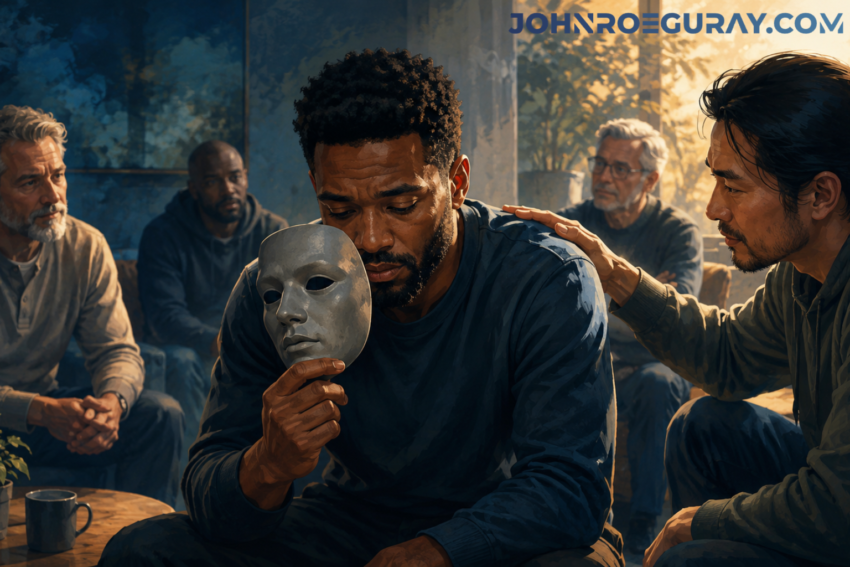
Every June, Men’s Mental Health Awareness Month invites us to confront a painful truth: too many men are struggling quietly, and too many are doing so because they were taught that silence is strength.
For generations, boys and men have absorbed messages that vulnerability is weakness, that asking for help is failure, and that emotional pain should be managed privately. The result is not resilience. Too often, it is isolation.
Men’s mental health has become a silent epidemic—not because men do not feel deeply, but because many have been conditioned to hide what they feel until the pain becomes too heavy to carry alone.
This awareness month is not just about naming the problem. It is about changing the culture around it.
The Numbers Tell a Sobering Story
Mental health challenges are common, but men often face unique barriers to recognition, treatment, and support. The CDC reports that roughly 23%—nearly 1 in 5—U.S. adults live with a mental health condition, while NAMI similarly notes that more than 1 in 5 U.S. adults experience mental illness each year.
Yet men remain less likely than women to receive mental health treatment. The National Institute of Mental Health notes that men are less likely to have received mental health treatment in the past year, even though early treatment can make care more effective.
The suicide gap is especially alarming. According to the CDC, the suicide rate among males in 2023 was approximately four times higher than the rate among females; males make up about half the population but nearly 80% of suicides.
These statistics should move us beyond awareness into urgency.
Why Men’s Pain Often Goes Unseen
One of the challenges in men’s mental health is that distress does not always look the way people expect it to look.
Depression is often associated with visible sadness, withdrawal, or crying. But in many men, depression or anxiety may show up as anger, irritability, frustration, emotional numbness, risk-taking, substance use, overwork, physical complaints, or sudden changes in behavior.
NAMI notes that men experiencing poor mental health may often feel irritable, angry, or frustrated, and may cope through substance use, aggression, or reckless behavior when they do not receive the information and support they need.
This matters because men are often judged by the behavior on the surface instead of supported through the pain underneath it. A man who is short-tempered may be written off as difficult. A man who overworks may be praised as driven. A man who goes quiet may be assumed to be fine.
But silence is not always stability. Sometimes silence is a warning sign.
The Weight of “Be Strong”
There is nothing wrong with strength. Men need strength. Families, workplaces, communities, and societies benefit from men who are steady, responsible, protective, disciplined, and dependable.
The problem begins when strength is defined as emotional suppression.
When men are taught that they must always be self-sufficient, they may struggle to admit fear, grief, exhaustion, loneliness, trauma, or shame. They may keep performing competence while privately falling apart. They may believe that their worth depends on how well they provide, endure, and stay composed.
This pressure can be especially intense for fathers, husbands, sons, leaders, immigrants, veterans, caregivers, workers, and men navigating major transitions. Many carry responsibilities that leave little room to ask, “What about me?”
But mental health does not improve by being ignored. Pain that is buried does not disappear. It leaks into relationships, parenting, decision-making, physical health, work, and self-worth.
Men do not need permission to be human. But many still need environments that make it safer to be honest.
Awareness Must Become Actionable Support
Men’s Mental Health Awareness Month should not be reduced to a hashtag or a one-month campaign. It should push us to change the way we show up for the men in our lives.
Break the stigma
Create homes, workplaces, gyms, churches, friend groups, and community spaces where men can speak honestly without being mocked, minimized, or immediately “fixed.”
A man should not have to reach a crisis point before someone takes his pain seriously.
Breaking stigma can be as simple as saying, “You don’t have to carry that alone,” and meaning it. It can mean leaders openly supporting mental health days, parents modeling emotional language for sons, and friends making room for conversations that go deeper than sports, money, or work.
Normalize check-ins
Many men will not volunteer that they are struggling. That does not mean they are okay.
Ask directly but gently:
“How have you really been?”
“What has been weighing on you lately?”
“Are you sleeping?”
“Do you feel like you have support?”
“Do you want advice, or do you just need me to listen?”
Then listen without rushing to correct, compare, or dismiss. Sometimes the most powerful support is not a solution. It is presence.
Notice symptoms that may not look like sadness
Pay attention to changes: irritability, isolation, loss of interest, increased drinking, reckless behavior, unexplained physical pain, exhaustion, sudden anger, hopeless language, or giving away possessions.
Men may not say, “I’m depressed.” They may say, “I’m tired,” “I’m done,” “Nothing matters,” or “Everyone would be better off without me.”
Take those statements seriously.
Connect men with real resources
Professional support should be normalized, not treated as a last resort. Therapy, support groups, crisis lines, peer communities, coaching, medical evaluation, and faith-based or community support can all play meaningful roles depending on the situation.
The point is not to force one path. The point is to make help feel accessible, practical, and acceptable.
Where Men and Families Can Find Support
For immediate emotional distress or suicidal crisis in the United States, the 988 Suicide & Crisis Lifeline is available by calling or texting 988, with online chat also available; 988 provides confidential support 24 hours a day, 7 days a week.
The National Alliance on Mental Illness offers education, advocacy, toolkits, and local community support through its awareness events and affiliate network. NAMI’s Men’s Health Month page specifically encourages communities to break the silence around men’s mental health and fight stigma.
The Movember Foundation provides men’s mental health and suicide prevention resources, including guidance on how to support men who may be struggling and broader campaigns focused on helping men live healthier, longer lives.
These resources are not only for moments of crisis. They are also starting points for conversations, education, prevention, and connection.
A Better Definition of Strength
We need to give men a better definition of strength.
Strength is not pretending nothing hurts.
Strength is not disappearing into work, anger, silence, or isolation.
Strength is not waiting until everything collapses before asking for help.
Strength can look like telling the truth.
Strength can look like making the appointment.
Strength can look like calling a friend.
Strength can look like staying alive through one more difficult night.
Strength can look like letting someone sit beside you while you stop pretending you are okay.
This June, Men’s Mental Health Awareness Month challenges us to listen more closely, speak more honestly, and support more intentionally.
Because the men in our lives are not machines. They are fathers, sons, brothers, husbands, friends, colleagues, neighbors, leaders, and human beings.
And no one should have to suffer in silence just to be seen as strong.