

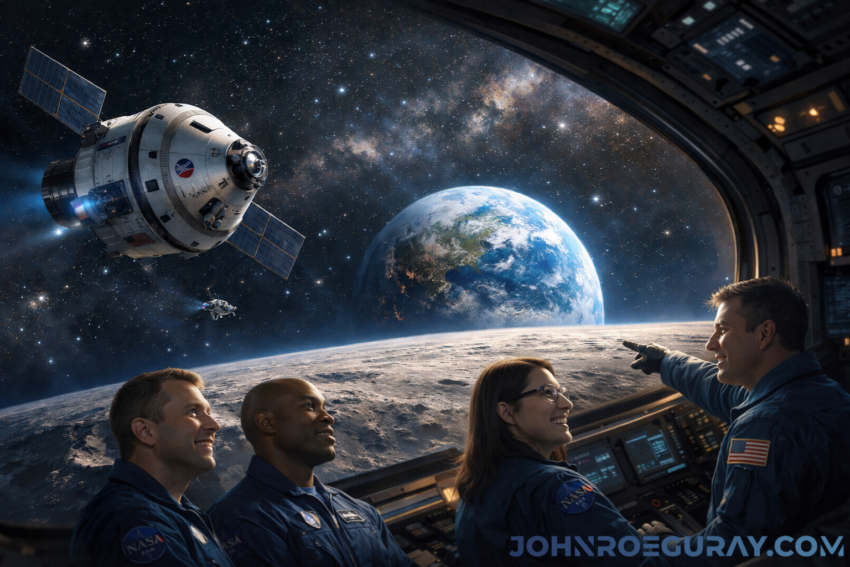
For generations, space exploration has represented humanity at its most ambitious—our desire to push beyond limits, to understand the unknown, and to redefine what is possible. With the upcoming Artemis II mission under the broader Artemis program, that spirit is being rekindled in a way that feels both nostalgic and urgently modern.
Unlike the early triumphs of the Apollo program, which were largely shaped by geopolitical rivalry, Artemis II arrives in a more complex world — one grappling with inequality, climate challenges, and rapid technological disruption. And yet, perhaps that is precisely why it matters more.
This mission is not just about returning to the Moon. It is about redefining why we go there at all.
A New Generation Looks Up Again
Artemis II has already begun to inspire—long before liftoff.
In classrooms, boardrooms, and households around the world, the idea of humans once again venturing beyond Earth orbit is igniting curiosity. For younger generations, who did not live through the Moon landings, Artemis is their first real connection to the frontier of space.
But inspiration today carries a different weight.
In the 1960s, space exploration symbolized victory and dominance. Today, it symbolizes possibility and shared destiny. The difference matters. The narrative has shifted from “who gets there first” to “what does it mean for all of us.”
That shift is where Artemis II draws its deepest power.
Inspiration Must Be Built on Purpose
Inspiration alone, however, is not enough.
History shows that excitement around space exploration can fade if it is not grounded in tangible benefits. The early Space Age gave us innovations—from satellite communications to materials science—but its momentum slowed when its purpose became less clear to everyday people.
For Artemis II to endure as more than a moment, it must connect space exploration to life on Earth:
- Climate monitoring and sustainability through advanced satellite systems
- Global connectivity bridging digital divides
- Scientific breakthroughs in medicine, energy, and materials
- Economic opportunity across new industries and geographies
The challenge is not technological—it is philosophical.
Space exploration must no longer be seen as a distant endeavor for a select few. It must become a shared investment in humanity’s future.
Avoiding a New Space Divide
As private companies and wealthy nations expand their presence in space, a new risk emerges: the creation of a “space divide.”
If access to space—and its economic benefits—is concentrated among a handful of players, then the next era of exploration could unintentionally widen the very inequalities we face on Earth.
Artemis II, led by NASA, offers an opportunity to set a different tone.
Through international partnerships and inclusive participation, it can demonstrate that space is not a luxury frontier, but a collective one. The question is whether the global community will follow through on that vision.
True inspiration is not just about witnessing greatness—it is about being part of it.
Humanity at the Center of Exploration
At its core, Artemis II reminds us that space exploration is a profoundly human endeavor.
Behind every launch are individuals—scientists, engineers, astronauts—whose work reflects our collective ingenuity. But more importantly, behind every mission is a question:
What kind of future are we building?
If space exploration becomes detached from human progress—if it prioritizes prestige over purpose—it risks becoming irrelevant. But if it remains anchored in improving life on Earth, it becomes one of the most powerful forces for unity and advancement.
From Inspiration to Responsibility
Artemis II has reignited something we have not felt at scale in decades—a sense of shared wonder.
But wonder alone will not sustain the journey ahead.
The Real Mission Begins Here
The true legacy of Artemis II will not be measured by how far it travels, but by how deeply it transforms our perspective. It challenges us to think beyond borders, beyond short-term gains, and beyond narrow definitions of success.
If we are to enter a new Space Age, it must be one built on:
- Inclusion, not exclusivity
- Purpose, not prestige
- Progress for all, not just for a few
Only then can inspiration evolve into something enduring—a foundation for a future where humanity does not just reach the stars, but rises together.