

Some stories stay with us because they are beautifully written. Others remain with us because they reveal something essential about who we are, who we hope to become, and what the world asks of us when another person is in pain.
For me, the Parable of the Good Samaritan has always been one of those stories.
It is one of my favorite passages in the Christian Bible, not only because of its message about kindness, but because of how deeply relatable it has become in my own life. Over time, I have come to understand that help does not always arrive from the people we expect. Sometimes, the ones who stand beside us during our most trying moments are not relatives, longtime friends, colleagues, or familiar faces.
Sometimes, they are strangers.
And sometimes, the people we assumed would stop simply keep walking.
A Story About More Than Kindness
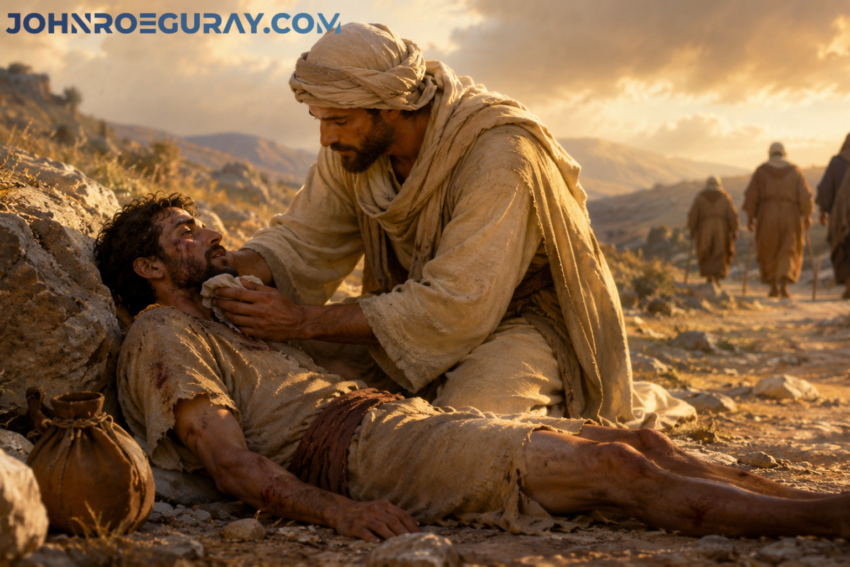
In the parable, a man is attacked, robbed, and left wounded on the side of the road. Several people see him, including individuals who would have been expected to help, yet they pass by. It is the Samaritan, someone considered an outsider, who stops, tends to the man’s wounds, brings him to safety, and takes responsibility for his care.
The story is often summarized as a lesson about being kind to others. But its meaning is far more challenging.
It asks us to confront the gap between what we profess and what we practice.
It reminds us that compassion is not proven by identity, status, affiliation, position, or proximity. It is proven by action. The person who becomes a true neighbor is not necessarily the one who knows us best, shares our background, or belongs to our circle. It is the one who sees our suffering and chooses not to look away.
That distinction matters.
Many people are surrounded by others and still feel profoundly alone. They may have large families, active social networks, professional relationships, or communities around them, yet find that when life becomes difficult, only a few people are willing to remain present.
The Good Samaritan reminds us that closeness is not always measured by history. Sometimes, it is measured by who stops.
When Help Comes From Unexpected Places
There have been moments in my life when I found myself navigating pain, uncertainty, personal transitions, and circumstances that were difficult to explain to others. In those moments, I became more aware of who was willing to listen, who showed empathy, and who offered help without judgment or expectation.
Some of the most meaningful acts of support came from people I barely knew.
A stranger who took time to listen.
A professional who treated my concerns with humanity rather than as a transaction.
A person who offered guidance, encouragement, or practical help without needing a personal connection to me.
Someone who simply acknowledged that what I was going through was real.
These experiences changed how I understand community.
We are often taught to believe that support should naturally come from the people closest to us. And when it does, it is a gift. But life can also reveal a more difficult truth: relationships do not always guarantee compassion, and familiarity does not always translate into presence.
At the same time, unfamiliarity does not prevent someone from showing extraordinary care.
The people who help us through our hardest seasons may not have known us before the crisis. They may never know our entire story. Yet they can still become part of our healing simply because they chose to be present when it mattered.
Compassion Is a Decision
One of the most powerful aspects of the Good Samaritan is that he did not merely feel sympathy. He acted.
He stopped his journey.
He moved toward discomfort.
He used his own resources.
He accepted inconvenience.
He helped without first determining whether the wounded man deserved assistance.
This is where compassion becomes leadership.
True compassion is not passive. It is not limited to expressing concern, offering thoughts, or acknowledging that suffering exists. It requires a willingness to respond.
In organizations, communities, families, and institutions, we often celebrate values such as empathy, inclusion, care, and service. Yet these values mean very little unless they are reflected in decisions and behaviors.
Do we make time for the person who is struggling?
Do we believe people when they say they are hurting?
Do we help only when it is convenient?
Do we avoid involvement because we fear discomfort, complexity, or responsibility?
Do we quietly pass by because someone else will probably step in?
The Good Samaritan challenges us to see that indifference is also a choice.
Passing by may feel neutral, but to the person left on the side of the road, it can deepen the wound.
The Strangers Who Restore Our Faith in People
There is something deeply humbling about receiving compassion from someone who owes us nothing.
When a stranger helps us, it restores more than our immediate situation. It can restore our faith in people.
It reminds us that goodness can still be found in unexpected places. It shows us that humanity is not limited by familiarity. It reveals that even in moments when we feel abandoned, unseen, or forgotten, someone may still choose to meet us with dignity.
That kind of kindness stays with us.
We remember the people who answered.
We remember the ones who followed up.
We remember the person who sat with us in uncertainty.
We remember who helped us breathe, think clearly, find a resource, make a decision, or take the next step.
These moments often seem small to the person offering help. But to the person receiving it, they can become turning points.
Becoming the Person Who Stops
The lesson of the Good Samaritan is not only about appreciating those who have helped us. It is also about deciding what kind of person we will be when we encounter someone else in need.
Will we notice?
Will we pause?
Will we listen?
Will we help even when there is no recognition, reward, or personal benefit?
Will we allow another person’s pain to interrupt our schedule?
The world does not suffer from a shortage of opinions. It suffers from a shortage of people willing to stop.
We do not need to solve every problem we encounter. We cannot carry every burden or respond to every crisis. But we can choose not to become so busy, guarded, skeptical, or self-focused that we stop seeing the humanity of others.
Sometimes, helping means providing practical support.
Sometimes, it means connecting someone to the right resource.
Sometimes, it means listening without trying to control the conversation.
Sometimes, it means believing someone whose experience has repeatedly been dismissed.
Sometimes, it means simply saying, “You do not have to face this alone.”
Our Neighbor Is the Person in Front of Us
The enduring power of the Good Samaritan is that it challenges narrow definitions of belonging.
A neighbor is not only someone who lives nearby.
A neighbor is not only someone who shares our religion, culture, profession, politics, identity, or social circle.
A neighbor is the person whose humanity is placed in front of us.
And being a neighbor is not about where we come from. It is about how we respond.
The people who have shown up for me during difficult times have reinforced this lesson in ways that no sermon or commentary ever could. They have reminded me that compassion can come from unexpected people, in unexpected places, at exactly the moment it is needed.
They have also reminded me of the responsibility that comes with receiving that kind of grace.
When someone stops for us, we are called to become more willing to stop for others.
The Legacy of Those Who Did Not Pass By
Most people will never know the full impact of the help they provide.
The encouraging message they sent.
The referral they made.
The time they gave.
The judgment they withheld.
The support they offered.
The simple decision to stay.
But those actions can become part of another person’s survival, recovery, and ability to move forward.
That is why the Good Samaritan remains so meaningful to me. It is not merely an ancient story about a wounded traveler. It is a timeless reminder of the kind of world we create through our everyday choices.
We create one kind of world when we pass by.
We create another when we stop.
And sometimes, the person who stops may be a stranger.
But in that moment, they become something more.
They become a neighbor.
They become proof that compassion is still alive.
They become part of the reason someone finds the strength to keep going.