

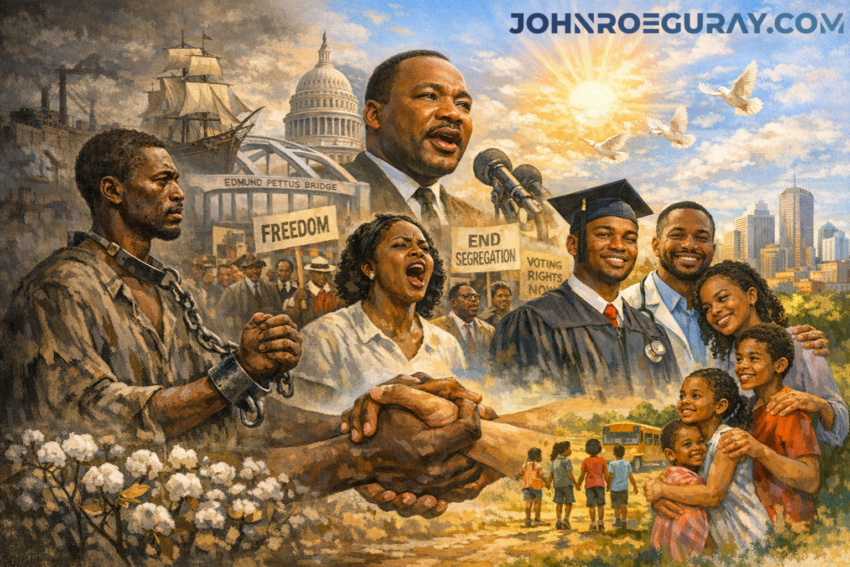
Every February, Black History Month invites us to reflect — not only on history, but on humanity. It is a time to honor the resilience, brilliance, and contributions of Black communities worldwide, while also confronting the enduring realities of racism that still shape societies today.
In 2026, this reflection feels especially urgent. Conversations about equity, belonging, and justice are evolving globally, yet the roots of racial inequality remain deeply embedded. Understanding those roots is essential if we want to move toward a future defined not by division, but by shared dignity.
Understanding the Origins of Racism Against Black People
Racism did not emerge naturally — it was constructed over centuries. During the transatlantic slave trade, pseudoscientific theories and cultural narratives were deliberately developed to justify the exploitation of African people. These ideas falsely framed Black individuals as inferior, enabling systems of slavery, colonization, segregation, and economic exclusion.
Over time, those narratives spread through institutions:
- Education systems that erased Black contributions
- Economic policies that limited opportunity
- Media portrayals reinforcing stereotypes
- Legal frameworks that codified inequality
Even after formal segregation ended in many countries, these structural patterns persisted, often subtly but powerfully.
Recognizing this history helps us move beyond simplistic assumptions and better understand why disparities still exist today.
The Generational Impact: Why History Still Matters
The effects of racism are not confined to the past — they ripple across generations.
Economic Impact
Historical exclusion from property ownership, education access, and capital accumulation created wealth gaps that persist today.
Social and Psychological Effects
Experiences of discrimination can influence mental health, identity formation, and community trust across generations.
Educational and Opportunity Gaps
Unequal access to resources continues to affect academic outcomes, career mobility, and entrepreneurship opportunities.
Understanding these realities does not assign blame — it builds awareness. Awareness is the first step toward dismantling prejudice and creating equitable opportunities.
Why Addressing Racism Matters: “No Justice, No Peace”
The phrase “no justice, no peace” reflects a simple truth: societies thrive when fairness exists. When injustice persists, tension, mistrust, and division follow.
Addressing racism benefits everyone because:
- Stronger economies emerge when talent isn’t limited by discrimination.
- Healthier communities develop when people feel respected and included.
- Innovation flourishes when diverse perspectives collaborate.
- Social stability improves when fairness replaces systemic inequity.
Justice is not only a moral imperative — it is a practical one.
Steps Toward Racial Justice and Lasting Peace
Progress requires intentional action at multiple levels:
1. Education and Honest Dialogue
Learning accurate history and engaging in respectful conversations reduce fear and misinformation.
2. Institutional Accountability
Organizations, governments, and businesses must evaluate policies to ensure equitable outcomes.
3. Economic Empowerment
Supporting Black entrepreneurship, investment access, and workforce development helps close opportunity gaps.
4. Personal Reflection
Challenging unconscious biases and practicing empathy are everyday actions that collectively shift culture.
5. Community Partnership
Collaboration across racial, cultural, and generational lines builds trust and shared progress.
None of these steps alone solves the problem — together, they move us closer to sustainable justice.
Imagining a World Beyond Racism
John Lennon’s song “Imagine” paints a picture of a world without divisions — a place where humanity comes before labels.
A future free from racism would mean:
- Children growing up without inherited prejudice
- Opportunities determined by talent, not identity
- Cultural differences celebrated rather than feared
- Global cooperation replacing suspicion and division
This vision may feel idealistic, but history shows that social change often begins with imagination. What once seemed impossible — abolition, civil rights legislation, broader representation — became reality because people dared to envision something better.
Honoring History, Building Tomorrow
Black History Month is not just about remembrance; it is about responsibility. By understanding the origins of racism, acknowledging its ongoing effects, and committing to justice, we help create conditions for genuine peace.
The journey is ongoing. But with awareness, empathy, and action, a more inclusive future is not only possible — it is within reach.
And perhaps one day, the world imagined in song — where humanity simply lives as one — will no longer be a dream, but a shared reality.